

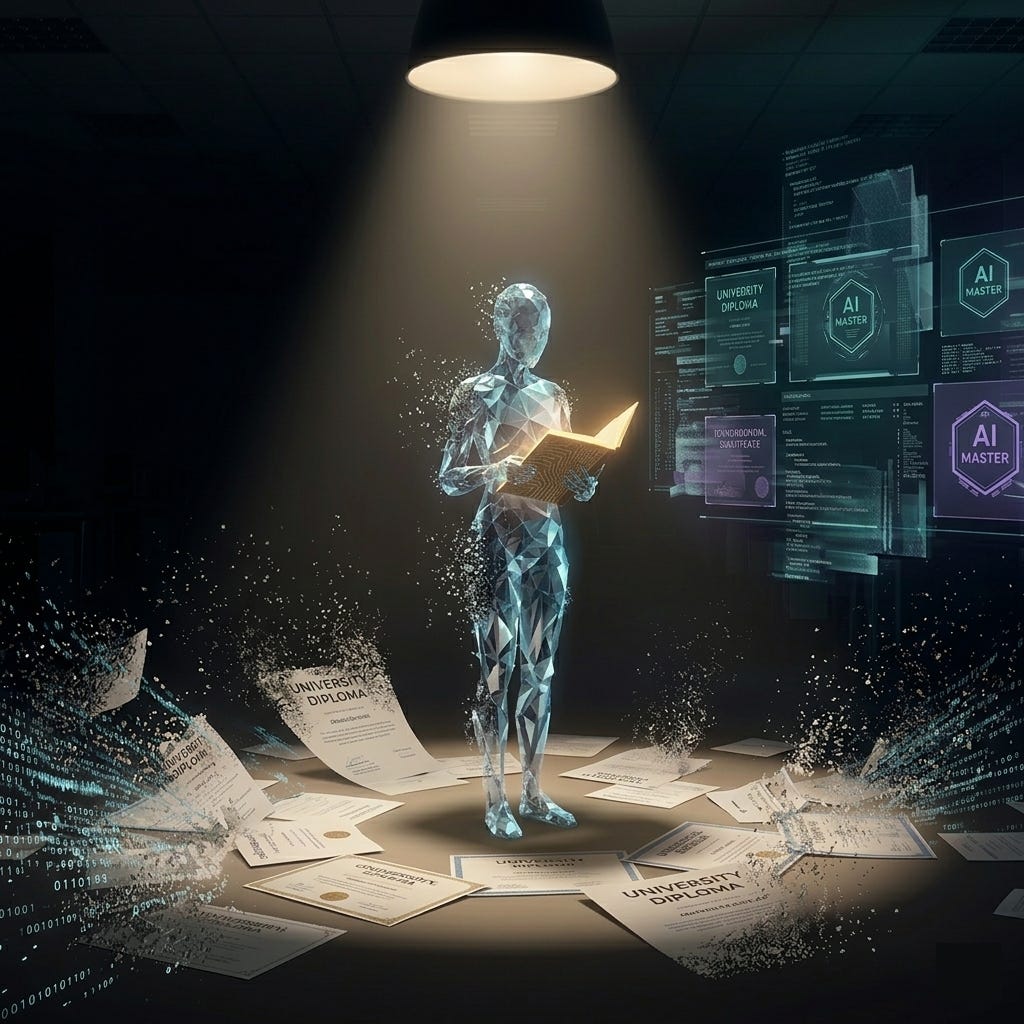
In 1950, you trusted your doctor because they had an MD. In 1980, you trusted your accountant because they had a CPA. In 2010, you trusted your consultant because they had an MBA. In 2026, AI has all three. And you don’t trust any of them anymore.
The credential collapse didn’t just kill gatekeeping. It killed the shortcut we used to decide who to trust.
For decades, credentials were trust proxies. You didn’t need to know someone personally. You didn’t need to see their work. The letters after their name did the vetting for you.
MBA = understands business.
CPA = won’t steal your money.
MD = knows how to heal you.
It was efficient. It was scalable. And it worked, until AI exposed that credentials never measured what we thought they did. They measured the ability to pass tests. Not judgement. Not ethics. Not the thing that actually makes someone trustworthy.
Now that credentials mean nothing, we have to rebuild trust from scratch. And we have no idea how.
The shortcuts we lost
Trust is expensive. It takes time to build. It requires repeated interactions. You have to observe someone’s behaviour, test their judgment, and see if they deliver when it matters. Credentials were the cheat code.
Instead of spending months evaluating someone, you could look at their resume and make a decision in seconds.
“Harvard MBA? Trustworthy.”
“Board-certified surgeon? Trustworthy.”
“20 years experience? Trustworthy.”
The system wasn’t perfect. Plenty of people with credentials were incompetent. Plenty of people without them were brilliant.
But credentials gave us confidence. Even if it was misplaced.
Now AI has the same credentials. And suddenly, we realise: the credential never proved the person was good. It just proved they jumped through the right hoops.
So what now?
When everyone, human or machine, can claim the same qualifications, how do you decide who to trust?
The return to proof of work
Here’s what’s happening: we’re reverting to the pre-credential era. When trust was earned through demonstrated ability, not certification.
Before there were MBAs, you proved you could run a business by running one. Before there were medical licenses, you proved you could heal by healing. Before there were credentials, reputation was everything.
And reputation was built slowly. One project at a time. One recommendation at a time.
The AI age is forcing us back to that model.
Because when anyone can generate a perfect resume, a flawless cover letter, and ace any interview question, the only thing that matters is: “Can you actually do the work?”
Not “can you talk about the work?”
Not “do you have a degree in the work?”
Can you produce results?
This is why portfolios are replacing resumes. This is why GitHub profiles matter more than CS degrees. This is why companies are hiring based on projects, not pedigree.
In the post-credential world, trust comes from proof of work.
Show me what you’ve built. Show me what you’ve solved. Show me what you’ve shipped. Words don’t build trust anymore. Output does.
The judgement premium
Here’s the problem, though: AI can produce output too. It can write code. Draft strategies. Analyse data. Generate reports.
So if trust is based on output, and AI can produce output faster and better than most humans, why would anyone trust a human at all?
Because output isn’t the same as judgement.
AI can execute. It can optimise. It can generate.
But it can’t decide what’s worth doing in the first place. It can’t tell you when to ignore the data. It can’t sense when a “perfect” solution will fail in the real world. It can’t navigate the messy, human, political dynamics of getting things done.
That’s judgement. And judgement can’t be automated.
This is the new trust signal: not “can you do the task?” But “do you know which task to do?”
In the credential era, trust came from knowing things.
In the AI era, trust comes from knowing what matters.
And the only way to prove that is through track record. Not a resume. Not a certification. A history of making the right calls when it wasn’t obvious what the right call was.
The network effect
Here’s the uncomfortable truth: in a world without credentials, trust becomes social.
You can’t rely on institutional validation anymore. So you rely on people who already trust you to vouch for you.
This is why personal brands matter now. This is why referrals are the new resume. This is why “who you know” is becoming more important than “what you know.”
Because when credentials collapse, networks become the new credential.
If someone I trust vouches for you, I’ll trust you. If you’ve worked with people I respect, I’ll give you a chance. If you’re embedded in a community that values quality, I’ll assume you do too. The trust rebuild isn’t happening at the individual level. It’s happening at the network level. And that creates a problem: if you’re not in the network, how do you get trusted?
In the credential era, you could break in by getting the right degree.
In the AI era, there’s no shortcut.
You have to build relationships. One at a time. Over time.
Trust is back to being what it always was: slow, personal, and earned.
The ethics question
When credentials collapse, so does accountability.
In the old system, credentials came with obligations.
Doctors had the Hippocratic Oath. Lawyers had professional ethics boards. Accountants had fiduciary duties.
If you violated those, you lost your credential. And with it, your career.
Now? There’s no governing body for “proof of work”.
If you build a great portfolio but behave unethically, who holds you accountable? If you deliver results but cut corners, who stops you?
The credential system had flaws. But it had structure. It had consequences.
The trust rebuild doesn’t.
We’re entering an era where trust is peer-to-peer. Reputation-based. Network-driven. That’s great for flexibility. But terrible for oversight.
Because reputations can be gamed. Networks can be insular. And without formal accountability, the most charismatic people, not the most competent, will rise.
So here’s the question: how do we rebuild trust in a way that doesn’t just reward performance, but enforces integrity?
I don’t have the answer. But I know we need one.
Trust as a skill
The credential collapse forces us to confront something we’ve avoided for decades: trust was never about the piece of paper.
It was about the relationship. The track record. The pattern of behaviour over time. Credentials were just a shortcut. And now that the shortcut’s gone, we have to do the hard work. Building trust is a skill now. Not a checkbox.
You can’t outsource it to a degree. You can’t fake it with a resume. You have to demonstrate it through your work, your decisions, and your integrity.
The people who figure that out will thrive.
The people waiting for credentials to matter again will be left behind.
Because in the AI age, trust isn’t something you earn once and carry forever.
It’s something you rebuild. Every day. With every decision.