

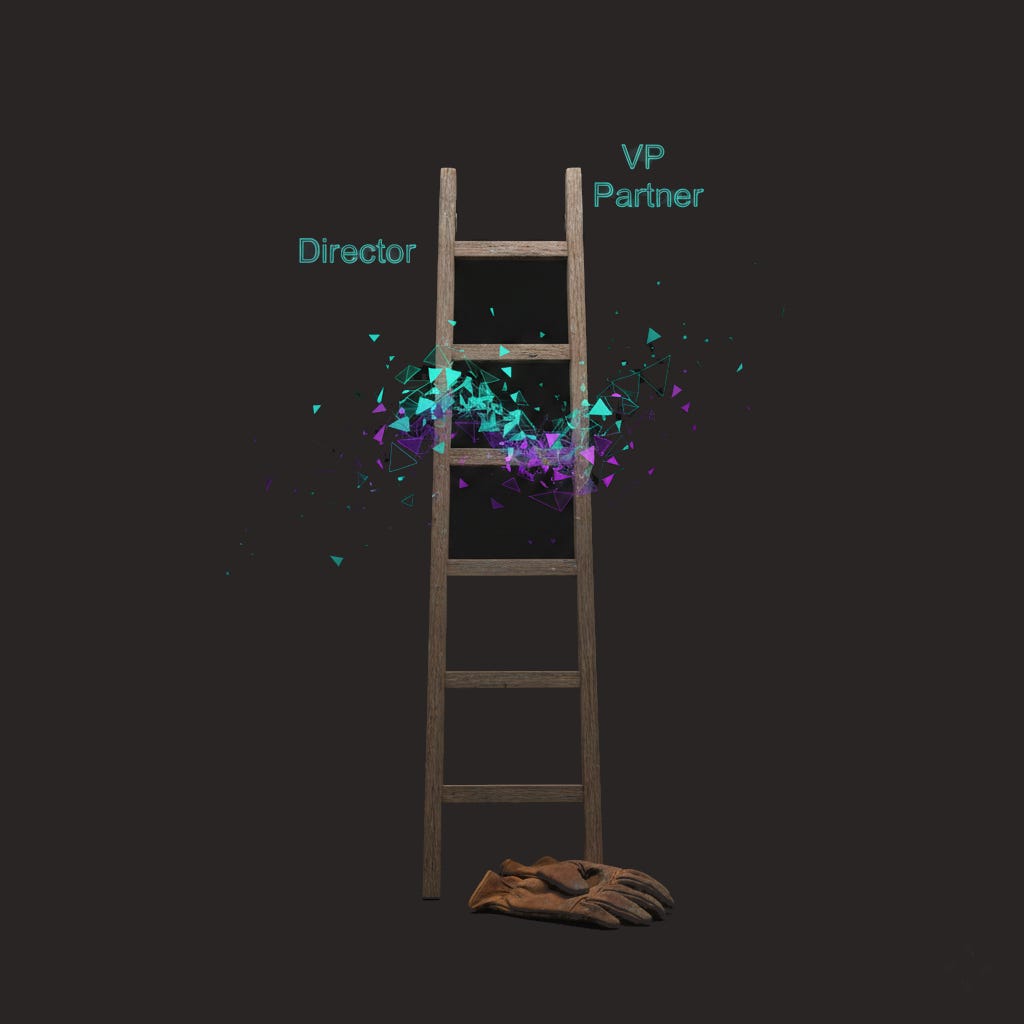
In the history of craft, there has always been a messy middle. It’s the period between being a clueless novice and a seasoned expert. In the 15th century, they called it an apprenticeship. In the 20th century, we called it being a Junior Associate, an Analyst, or an Intern.
It was the time you spent doing the grunt work: summarising meeting notes, cleaning up data sets, drafting basic templates, and formatting endless slide decks. We tolerated this labour because it was the price of admission. It was how you developed intuition.
By 2026, that period has been deleted.
With a single “Summarise this” or “Draft a strategy based on X” prompt, the work that used to take a junior three days now takes a Senior three seconds. On the surface, this looks like a productivity miracle. Beneath the surface, we are witnessing the collapse of the professional pipeline.
The anatomy of a stolen apprenticeship
Expertise is not a database of facts; it is a library of patterns. You don’t become a master architect by looking at finished buildings; you become one by drawing ten thousand doors until you understand why a door shouldn’t be three inches to the left.
The grunt work was never about the output.
It was a cognitive training ground. When a junior summarises a 50-page transcript, they aren’t just producing a summary; they are participating in an cognitively engaging filtering exercise.
They learn to hear the subtext in a CEO’s hesitation.
They observe how senior leaders handle disagreement.
They absorb the unwritten rules of corporate culture through sheer exposure.
When we hand that task to an LLM, the senior gets the summary, but the junior gets...nothing. No pattern recognition. No struggle. No intuition. We are optimising for the artifact (the summary) while destroying the process (the learning). We are effectively removing the loading screen of a career, forgetting that the loading screen is where the data actually transfers.
The rise of the paper senior
We are approaching a crisis of synthetic experience. Imagine a pilot who has spent 10,000 hours in a simulator where the weather is always perfect and the autopilot never fails. On paper, they are a veteran. In a storm, they are a liability.
In 2026, we are minting paper seniors. These are professionals who have accelerated through their early years using AI as a cognitive exoskeleton. They can produce the output of a Director—the decks look right, the emails sound professional, the strategies are optimal—but they lack the scars of execution.
The paper senior doesn’t know what it’s like to stay up until 3am fixing a broken model because the AI fixed it for them. They don’t know the smell of a bad deal because they never had to manually vet the data. When the AI hallucinates—or worse, when a problem arises that has no historical precedent—the paper senior is paralysed. I have said it numerous times: they have the tools, but they don’t have the plumbing.
The senior-only economy and the Ponzi scheme of talent
The economic incentives are currently aligned against the future. CFOs are looking at departmental budgets and realising that a senior + AI is more efficient than a senior + two juniors. The junior is now seen as a training liability, an expensive human who takes up time and produces work that a bot can do for pennies.
But this is a Ponzi scheme of human capital.
If we don’t hire juniors today because the AI can do the entry-level stuff, where will the seniors of 2035 come from? You cannot prompt your way into twenty years of wisdom. Wisdom is the byproduct of a thousand corrected mistakes.
By refusing to pay for those mistakes today, we are ensuring a total leadership vacuum in a decade.
We are consuming the seed corn of our industries to satisfy this quarter’s efficiency targets.
The stolen friction problem
There is a dangerous myth that if we automate the boring stuff, humans will spend all their time doing high-level strategic thinking.
This is a lie.
High-level strategic thinking is the result of having mastered the boring stuff. You cannot strategise about a system you don’t understand at a granular level. By removing the friction of the early career—the struggle to get things right, the embarrassment of a bad first draft, the manual labour of research—we are stealing the very experiences that build the human premium.
Friction is where the heat of learning happens.
Without it, the brain remains “cold.” A generation of workers who have never had to struggle with a spreadsheet will never understand the inherent fragility of data.
Tactical preservation: the manual manifesto
To survive the expertise gap, organisations and individuals must intentionally re-introduce artificial friction. We need to move from “AI-First” to “Development-First.”
The draft in the dark rule: for the first two years of a career, juniors should be required to produce the first 20% of any project—the core logic, the outline, the raw research—without any AI assistance. The goal is to prove they can build the engine before being allowed to drive the car.
Shadowing as a KPI: we must stop measuring output per hour and start measuring exposure hours. If a senior uses an AI to automate a task, that saved time must be legally (or culturally) mandated for mentoring the junior who would have otherwise done the task.
The intuition tax: when a junior uses an AI to generate a solution, they must be able to explain the why behind every choice the AI made. If they can’t explain the plumbing, the work is rejected, no matter how perfect it looks.
Hiring for deviance: stop hiring juniors based on how well they use tools. Start hiring them based on their ability to spot where the tool is being median. Hire the ones who ask the annoying, first-principles questions.
The Future is lumpy
The corporate world is becoming lumpy: a few highly paid, hyper-efficient seniors at the top, and a vast, automated void underneath them.
To survive 2026, you cannot afford to be efficient. Efficiency is for machines. Your goal, whether you are a junior trying to break in or a senior trying to lead, is to protect the struggle. Because in the struggle, we find the expertise that no prompt can replicate.
The expertise gap is opening. Don’t fall into it by trying to be fast. Climb out of it by being deep. If you are a leader, your job isn’t to optimise your team’s output; it’s to protect your team’s growth. If you are a junior, your job isn’t to use the tool; it’s to out-think the person who designed it.
The era of skipping the line is over. It’s time to get back to the work.