

The bids team at a mid-sized engineering firm used to take three weeks to turn a client brief into a submitted proposal. After the AI rollout, the first draft came back in a day and a half. It was good. Not good enough to send unedited, but genuinely good — structured, costed, referencing the right precedents. The team lead sent it to legal on a Tuesday morning and, with entirely reasonable confidence, told the client to expect it by Friday.
Legal was one person. Legal had been one person before the rollout, and nobody had thought to change that, because the rollout was about drafting and legal review is not drafting.
Within a quarter the bids team was producing eleven proposals a week. Legal could review two. The firm’s average response time to clients — the only number the client actually experiences — moved from twenty-two days to twenty-six. It took another full quarter for anyone to notice, because every internal metric anyone was watching had improved dramatically. Time to first draft: down 90%. Drafts produced per head: up 14x. Employee-reported time saved: substantial. Every one of those numbers was true.
This is not a story about a badly run rollout. It is very close to the median story, and the aggregate data says so. In July 2025, MIT’s Project NANDA published The GenAI Divide: State of AI in Business 2025, based on more than 300 enterprise deployments, 52 structured case-study interviews and 153 leadership surveys. Their headline finding — that roughly 95% of an estimated 30 to 40 billion dollars in enterprise generative AI spend had produced no measurable profit-and-loss impact — briefly moved markets and was then mostly absorbed into the general noise of AI commentary, filed under the reassuring heading of “early days.”
It is not early days. It is the third year. And the reason so much of that spend evaporated is not that the technology underdelivered. In most of these deployments the technology did exactly what it said on the tin. The problem is that the thing it made faster was never the thing that was slow.
What the report actually said, and what everyone heard
The MIT authors were reasonably direct about where the failure sits.
“The core barrier to scaling is not infrastructure, regulation, or talent. It is learning.”
— Aditya Challapally, Chris Pease, Ramesh Raskar et al., The GenAI Divide: State of AI in Business 2025, MIT Project NANDA
What most readers heard was a claim about the models — that the tools do not retain feedback or adapt to context, which the report also says. But read the sentence again with an organisational eye and it says something broader and more uncomfortable: the barrier is not any of the things a company can purchase. It is the thing a company has to change about itself. And the specific thing most companies did not change is the shape of the path work takes through people.
Gallup’s 2026 workplace research gives that gap a number. For the first time in their measurement, half of employed American adults say they use AI in their role at least occasionally, with 13% using it daily. And yet only about one in ten employees inside AI-adopting organisations strongly agree that AI has transformed how work gets done where they work. Gallup’s own reading is that the benefits are concentrated at the level of individual tasks rather than workplace systems, because most organisations have not redesigned workflows, roles or processes around the technology at all.
Individual speed: up. Organisational throughput: essentially unchanged. That is not a paradox in need of resolving. It is the predictable result of optimising a link in a chain that was never the constraint.
We have run this experiment before
None of this should have surprised anyone, because there is an unusually well-documented precedent. In 1987 Robert Solow made the observation that became the productivity paradox: you could see the computer age everywhere except in the productivity statistics. Firms had spent enormously on computing through the late 1970s and 1980s, and measured productivity growth had gone sideways. The eventual resolution, worked out across a large literature over the following two decades, was not that computers were useless. It was that the gains required complementary organisational investment — different processes, different job designs, different decision rights — and those investments take years, cost real money, and depress measured productivity while they are being made. Firms that bought the computers and kept the workflow got the paradox. Firms that redesigned around the computers got the gains, roughly five to seven years later.
There is an even older piece of arithmetic underneath it. Amdahl’s law, formulated for parallel computing in 1967, says that the speedup available from accelerating any part of a system is capped by the fraction of the system you did not accelerate. Make one stage of a process infinitely fast and the overall improvement is still bounded by everything else. If the drafting stage was 20% of the elapsed time from brief to submitted proposal, then reducing drafting to zero — not by 90%, to zero — improves the whole process by at most 20%. And drafting was almost never 20%. In most knowledge-work chains it is closer to 10%, with the remaining 90% consisting of waiting: for a review, for an approval, for a meeting where three teams can be in the same room, for a decision-maker to have thirty uninterrupted minutes.
The Atlanta Fed’s March 2026 working paper, drawing on a survey of nearly 750 corporate executives, gives the current version of the Solow observation its formal name. The authors document what they call a productivity paradox in the AI era: perceived productivity gains are consistently larger than measured productivity gains. Executives are not lying. They are reporting something real — the acceleration of the visible, individual, task-level work — and then discovering that it does not appear in the aggregate, because the aggregate was never governed by that stage.
The mechanism: why it is a tax and not merely a disappointment
Here is where the story turns from “less benefit than hoped” to something with a genuine cost attached.
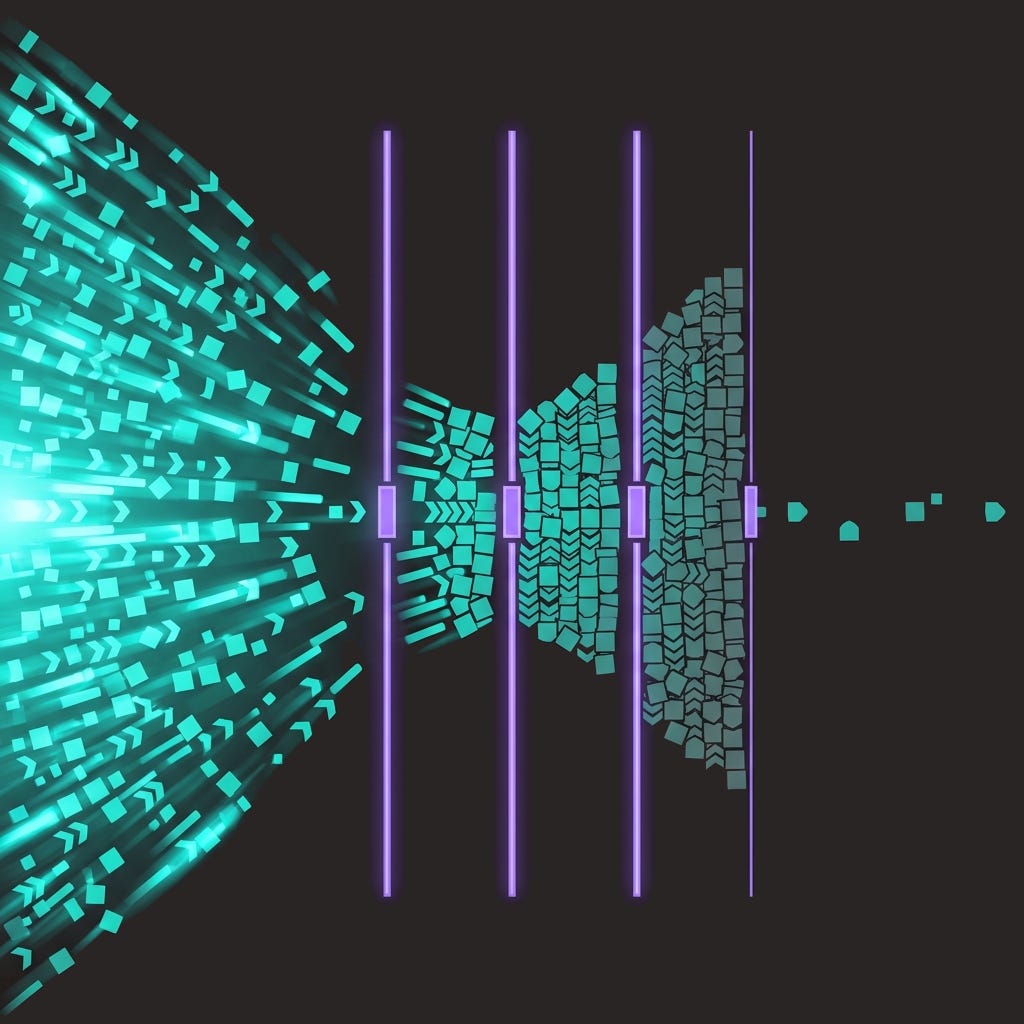
Treat any work chain as a queueing system, because that is what it is. Work arrives at a stage, waits, gets processed, moves on. In a system like this, total throughput is governed entirely by the slowest stage, and the only reliable way to make the system faster is to widen that stage. Speeding up a stage that was not the constraint does not improve throughput at all. Worse, it increases the arrival rate at the next stage downstream. If the downstream stage’s capacity is unchanged, the queue in front of it grows, and the average time work spends in the system goes up.
This is not a metaphor. It is the actual mechanism in the proposal story: eleven drafts a week arriving at a reviewer with a capacity of two produces a growing backlog, a longer average wait, and a client experience that gets measurably worse while every internal dashboard reports triumph. The organisation has not eliminated a bottleneck. It has fed one.
The coordination tax is the charge this system levies at every point where work passes between a person doing it and a person who must respond to it. It is paid per handoff. It is levied in elapsed time, in re-explanation, in meetings convened to resolve what a handoff failed to transmit. And it is almost completely indifferent to how fast the work itself was produced — which means that as production accelerates, the tax does not fall as a share of the total. It rises. It becomes, in relative terms, nearly the whole cost.
Most organisations have never measured it, because no individual pays it. It is charged to the space between people, and no one owns that space. It appears on no team’s dashboard, in no one’s objectives, and in no vendor’s ROI model. It is precisely the sort of cost that survives a decade of efficiency programmes untouched, and then quietly consumes the entire benefit of the next one.
The second charge: coordination gets more expensive, not just no cheaper
If the tax merely stayed constant while production accelerated, the picture would be disappointing but stable. The evidence suggests something worse: introducing AI into collaborative work tends to raise the cost of the coordination itself.
Reviewing the human-AI teaming literature, Schmutz and colleagues find that adding AI to a team frequently reduces coordination, communication and trust — that human-AI teams underperform not because the AI is weak but because team cognition and mutual understanding degrade. The mechanism is intuitive once stated. Coordination between people runs on a shared model of what each other knows and has actually thought about. When a colleague sends you a document, how carefully you check it has always depended on your read of how carefully they made it. Remove your ability to infer that — because the artefact could plausibly have been produced with five minutes of prompting or five hours of reasoning, and looks identical either way — and your only rational response is to check more.
So verification effort per handoff rises at exactly the moment volume per handoff rises. Reviewers who could previously skim a colleague’s work because they knew the colleague now have to read it properly, on three times as many documents. Approvers who could take a recommendation on trust now ask for the reasoning. Alignment meetings that used to converge on two credible options now have to work through six, because generating options got cheap and choosing between them did not.
This is the part organisations consistently fail to anticipate. They model AI adoption as a reduction in production cost with coordination cost held constant. In practice production cost falls, volume rises, and coordination cost per unit rises simultaneously. Three variables moving, only one of them modelled.
The four tolls
The coordination tax is not a single charge. It is collected at four distinct gates, and separating them matters, because each one has a different remedy and only one of them got cheaper after AI arrived.
The Approval Toll. Work waits for someone with authority to say yes. This is the purest form of the tax, and the most brutally unaffected by AI: the time cost is set entirely by the approver’s calendar and attention, both of which are fixed. Where an approval chain has three signatures, AI can compress the drafting from three weeks to two days and the elapsed time will fall from, say, thirty-five days to thirty-one. The visible work was never the number. The signatures were.
The Context Toll. Every handoff requires the receiver to be brought up to speed on what the sender knows. AI makes this toll worse in a specific and under-appreciated way: it dramatically increases the number of artefacts in circulation without increasing the shared understanding behind them. More documents, more variants, more options — each of which arrives at a colleague carrying less implicit context than a hand-made artefact would have, because the person who sent it may not hold all of that context themselves.
The Alignment Toll. Multiple parties must agree before anything moves. This toll scales with the number of options on the table and the number of people who must converge, and AI inflates the first term hard. When producing a strategic option costs an afternoon rather than a fortnight, teams arrive at the alignment meeting with six credible directions instead of two. Generation got a hundred times cheaper; agreement got no cheaper at all, and now has three times as much to agree about.
The Verification Toll. Someone must check the work before it counts. This is the toll that AI has damaged most directly, for the reason described above: volume rises while confidence per artefact falls, so total verification load rises on both axes at once. It is also the toll most likely to be quietly skipped under pressure, which converts a coordination problem into a risk problem without anyone deciding to accept the risk.
Read the four together and the pattern is stark. Of the four gates where organisational time actually goes, AI has meaningfully improved exactly none, made three actively more expensive, and been sold on its ability to accelerate a fifth stage — production — which was rarely the binding constraint in the first place.
The variable that actually predicts it working
There is a version of this story where AI produces real, compounding, measurable returns. It exists. The 5% in the MIT study are not statistical noise; they were extracting millions in value. The interesting question is what separates them, and the most useful answer in the current literature has nothing to do with tooling.
Wang, Feng and Sun built an inter-firm mobility network from 460 million job records covering more than 16,000 US companies, tracking how AI capability spreads between firms through the movement of AI workers. They found productivity spillovers two to three times larger than those historically associated with traditional IT — a striking result on its own. But the effect was conditional in a way that should reframe how leaders think about AI strategy entirely: hiring AI talent out of flatter, more lean-startup-intensive firms generated significant productivity gains, while hiring from firms lacking those traits yielded little benefit. Their mechanism tests point to flat and lean organisations producing more versatile AI generalists who carry richer, more transferable knowledge with them.
Same technology. Same models, available to everyone at the same price. Comparable people. Different organisational shape, radically different outcome. The authors’ broader framing is that AI spillovers, unlike IT spillovers, depend on experimental and integrative environments rather than on scale and process standardisation — which is another way of saying that the returns accrue to organisations with short paths between the work and the decision.
Which is the whole argument in a sentence. AI is not a productivity technology at organisational scale. It is an amplifier of whatever coordination structure you already had. In a flat organisation with few gates it compounds. In a layered one it congests. And the standard response to congestion — buying more AI, because the first deployment “clearly worked, look at the time-saved numbers” — is paying the same toll twice.
What to actually do about it
For individuals, the strategic implication is uncomfortable but clarifying: your visible output has stopped being a differentiator, because everyone’s rose at the same time. What is now scarce is the ability to move work through people — knowing who actually decides, what they need in order to decide, how to get a clean yes on the first pass rather than the third, and when to skip a gate entirely because it exists for historical reasons nobody can articulate. This was always undervalued relative to production skill. It is now the constraint, which means it is where the returns are.
For managers, the single highest-leverage act is to instrument the whole chain rather than the fast link. Almost every AI dashboard currently in use measures time saved per task, adoption rate, and self-reported productivity — three metrics that will report success indefinitely regardless of whether anything reaches a customer faster. Replace them, or at least outrank them, with elapsed time from request to delivered, and with queue depth at each internal handoff. The second number is the one that will be unpleasant, and it is the one that tells you where your ceiling is.
For leaders, the arithmetic to internalise is Amdahl’s: the return on accelerating any stage is capped by the fraction of elapsed time that stage represents. Before the next tool purchase, map where elapsed time actually goes for one important piece of work — genuinely map it, in days, from request to delivery — and count how much of it is production versus waiting. In most organisations the ratio is bad enough to make the case on its own. If 85% of elapsed time is waiting at four gates, then removing a gate is worth more than any conceivable improvement in the model behind the drafting.
And for anyone designing an organisation from here: the Wang, Feng and Sun result suggests the highest-return AI investment available to most firms is not an AI investment at all. It is delayering. Every gate removed is a toll no longer charged, on every piece of work, forever — and unlike a tooling upgrade, nobody can buy the same advantage next quarter.
The ceiling nobody put on the slide
The seductive thing about the coordination tax is that it is invisible from inside every role that pays it. The person drafting sees their own work getting faster and concludes the system is faster. The reviewer sees an unmanageable queue and concludes the drafters are being careless. The executive sees a dashboard of time-saved metrics and concludes the rollout succeeded. The client sees a response arriving twenty-six days after they asked, four days later than last year, and concludes nothing at all, because they have nothing to compare it against.
Not one of these people has an incorrect view of what they can see. The tax lives in the space between them, which is exactly the space no dashboard covers, no individual owns, and no vendor sells a fix for. It is the reason 95% of an enormous investment produced nothing measurable, and it is also the reason the remaining 5% produced so much: they had fewer gates to begin with, not better models.
The uncomfortable truth is that the last three years have been a very expensive natural experiment testing a hypothesis nobody stated out loud — that the constraint on knowledge work was individual production capacity. The experiment has now returned a fairly clear result, at a cost of tens of billions of dollars, and the result is no. The constraint was the structure. It always was. AI simply removed the last remaining excuse for pretending otherwise, by making the production side so fast that there is nothing left to blame.
You did not buy a faster organisation. You bought a faster way to reach the queue.
The point about speeding up one part of a process without addressing the bottleneck is easy to overlook, but it can make the overall workflow slower rather than faster.