

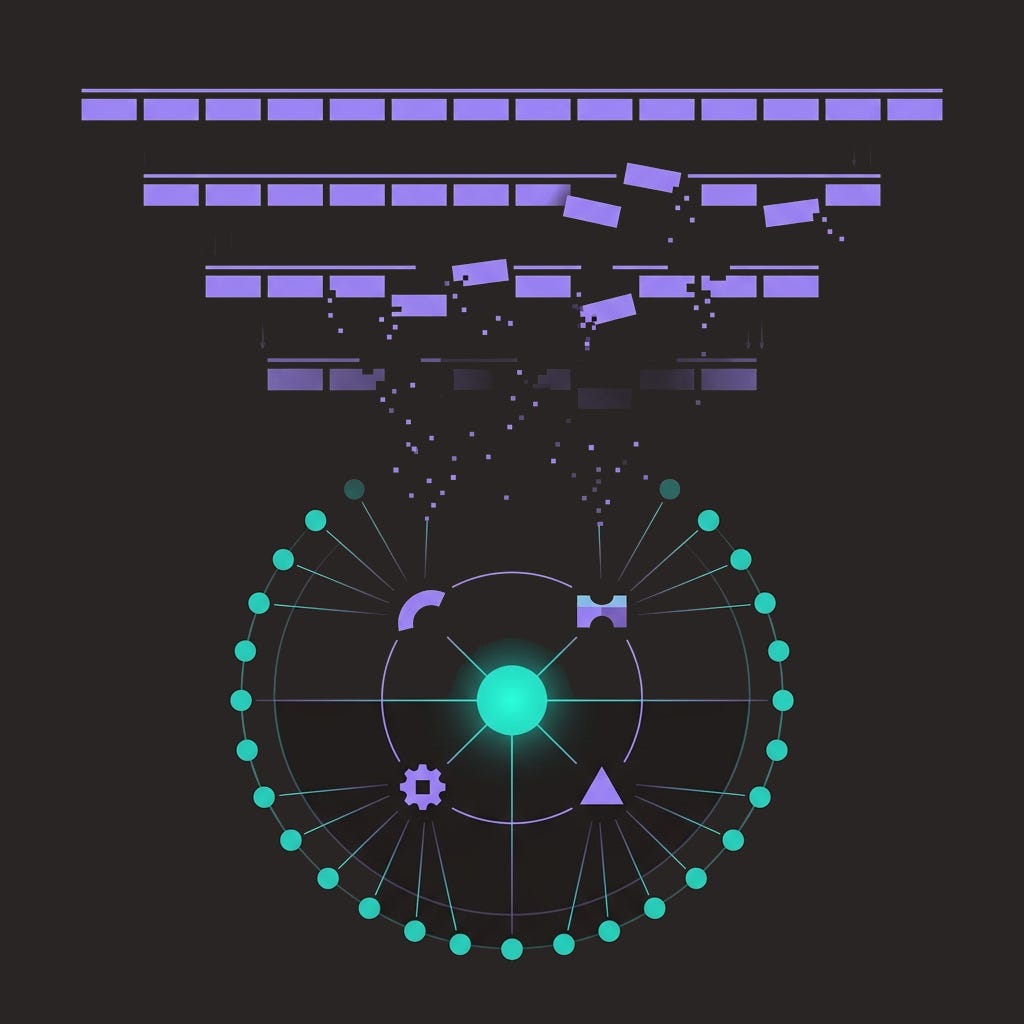
In October 2024, Gartner published a forecast that, if you read it slowly, has a particular cruelty to it. By the end of 2026, one in five organisations would use AI to eliminate more than half of their middle management roles. Read past the percentages and what the sentence actually says is this: within 24 months, in every fifth company, the people whose business cards currently say “Senior Manager”, “Director”, or “Head of” will, in the majority, not have jobs that match those titles any more.
It was a forecast. The forecast is now nearly resolved. Microsoft’s security engineering unit has doubled span of control from 5.5 to 10 direct reports per manager. Gusto’s analysis of US firms shows the average supervisor moved from three direct reports in 2019 to six in 2025. McKinsey has cut roughly 5,000 internal roles since 2023 — about a tenth of its workforce — and senior partner Rob Levin has described the operating model that follows in a sentence that should be pinned to every CHRO’s monitor: “a more flat network of human teams supervising AI agents.” Middle-management share of layoffs rose from 20% of all cuts in 2019 to 32% in 2023, a roughly 60% increase in their share of the pain.
Last week, in the first piece of this series, I introduced the five AI engines — generative, predictive, perceptive, agentic, optimisation — that will run the 2030 enterprise. This week’s question is the structural follow-up, and it is the one most organisations are not ready for: who runs them?
The answer is not “your existing middle manager, with an AI Copilot.” It is a structurally different role I’ll call the AI Operator — and importantly, it is not one role but four. The AI Operator arrives as four named archetypes: the AI Conductor, the AI Translator, the AI Mechanic, and the AI Surgeon. Each is suited to a different kind of workflow. Each is recruited from a different pre-AI profile. Two or three of the four typically have to coexist inside any production stack of any complexity. This piece is about what each archetype does, what they replace, who makes the jump into each one, and — most uncomfortably — why most of the people currently holding “manager” in their titles will not be the ones to occupy the new layer.
“Now we’re moving to this more flat network of human teams supervising AI agents.” — Rob Levin, Senior Partner, McKinsey, 2025
That sentence is doing a lot of work. It quietly replaces the entire mental model of an organisation as a stack of human reporting relationships with a different mental model: a network of small human pods, each of which orchestrates a fleet of non-human workers. It also implies, with no ceremony, that the supervisory layer in between — the layer that has dominated white-collar work since Sloan and Ford — is no longer the load-bearing structure.
What the middle manager actually does today
If you strip the title back to its operational components, the middle-management role is three jobs stitched together. They are recognisable in every department, every industry, every flavour of corporate work.
Information triage. The middle manager reads the reports, the dashboards, the customer feedback, the engineering tickets, the financial summaries. They turn that intake into structured output: a status update for the next layer up, a brief for the next layer down, a translation across the lateral function that doesn’t speak the same vocabulary. They are, in network terms, a routing node — taking dense raw information from one part of the org and reformatting it for another.
Work distribution. They decide who picks up the new ticket. They negotiate priorities when two stakeholders both want a thing now. They run the morning standup that aligns the four sub-teams. They escalate the blocker. They reshuffle the schedule when someone calls in sick. They are, in operating terms, the scheduling and dispatch layer.
People coordination. They do one-on-ones, performance reviews, hiring loops, growth conversations, career planning, conflict mediation, and the slow, accumulating work of building a team that works well together. They are, in human terms, the steward of the unit’s social fabric.
For most of the 20th century, fusing these three jobs into one human role was not just sensible: it was structurally necessary. The same person had to read everything anyway. Information triage was the most expensive part of the role, and once you had paid the cost of one human reading everything, you might as well also have them distribute the work and coordinate the people. Three jobs, one salary, one office, one expensive sip of organisational attention.
That logic held until 2023.
How AI absorbs two of the three
The mechanism is unsentimental. Generative AI absorbs information triage — at first imperfectly, then competently, then, in well-tuned setups, better than the human did. Reports get summarised, dashboards get narrativised, customer feedback gets clustered into themes, engineering updates get translated into language the rest of the business understands. The work that used to consume two-thirds of a manager’s day is now a function call.
The agentic stack absorbs most of work distribution. Tickets route themselves, priorities resolve themselves based on stated rules, standups become asynchronous summaries generated overnight, schedules optimise themselves around availability and dependencies. The dispatcher function — once human — becomes a coordination layer that runs in the background of the workflow. The orchestration patterns are explicit: hierarchical supervisor-worker, swarm, pipeline. Databricks, Microsoft, IBM, and a dozen agent-framework vendors are shipping the reference architectures for it now.
What is left over is people coordination. Which is real, valuable, irreducible work — but it is also, on its own, a fraction of a role. You do not need a full-time manager whose only job is one-on-ones and hiring loops. You need that work done well by someone whose actual job is something more substantial.
This is the structural fact most organisations have not faced. When two-thirds of a role’s day-to-day evaporates into a workflow, you do not solve it by adding an AI Copilot to the manager and asking them to be 40% more strategic. You redraw the role.
The role you redraw to is the AI Operator.
What the AI Operator actually does
Three things, and none of them are what the middle manager does today.
Stack design. Which AI engines run which parts of which workflow. Where the verification gates sit. Where a human stays in the loop and where the agent has authority to act unsupervised. What the escalation paths look like when something exceeds the agent’s confidence threshold. This is the work of an architect, not a coordinator. It requires knowing what each of the five engines can and cannot do, knowing where their failure modes sit, and knowing how to compose them into a workflow that produces a result the business can defend.
If you have not designed a multi-step workflow that involves more than one AI capability and more than one verification gate, you have not yet done the work an AI Operator does.
Failure-mode engineering. What happens when the agent hallucinates a customer name. What happens when the predictive model drifts because the training distribution no longer matches the operational one. What happens when the perceptive model fails silently — confidently reporting “no defect” while the line keeps producing defects. What happens when the optimisation engine maximises the wrong proxy and the business goes sideways.
The AI Operator’s job is to know — in advance, by design — what failure modes exist and what the escalation, recovery, and fallback paths are. The job is closer to an SRE designing for fault tolerance than a manager designing for performance reviews. Gartner forecasts that 40% of agentic AI projects launched in 2025 and 2026 will be cancelled by 2027 — overwhelmingly not because the technology fails, but because nobody designed for the failures. That gap is the AI Operator-shaped hole in most current organisations.
Throughput accountability. A small human team — three to five people, increasingly — plus a fleet of agents that may number in the dozens. McKinsey’s reference number, from Rob Levin, is that 50 to 100 agents can be supervised by two or three humans in a well-designed setup. The AI Operator owns the team’s output, the agents’ output, the cost of running the stack, and the quality bar across the whole.
This is closer to a plant manager than a people manager. Outcomes are measured at agent-level metrics, not human-hour productivity. The dashboard the AI Operator watches is not “tickets completed per person per week”; it is something more like “successful workflow completions per dollar of compute, with verified output, broken down by failure mode.”
The shape of an AI Operator’s day
To make this concrete: where the middle manager’s calendar in 2023 was 60% meetings, 25% email, 15% strategic thinking, the AI Operator’s calendar in 2027 looks closer to 30% workflow design, 25% failure-mode review, 20% quality audits and agent fine-tuning, 15% one-on-ones with the small human team, and 10% upward and lateral conversations with adjacent AI Operators.
The meetings that remain are mostly substantive: a weekly review of agent failure cases, a fortnightly stack-architecture review with peers, monthly performance conversations with the small human team.
The status meeting — the one that defined a generation of corporate work — is, for the AI Operator, gone. The agents file the status.
The AI Operator reads it the way an air-traffic controller reads a board: looking for the one signal that needs attention.
The four AI Operator archetypes
The AI Operator does not arrive as a single job. The work splits cleanly into four archetypes, each one suited to a different kind of workflow and a different temperament. Most production stacks need two or three of them spread across two or three humans. A handful of small teams will have someone who plausibly does all four — but they are rare, and increasingly expensive.
The four are the Conductor, the Translator, the Mechanic, and the Surgeon. They are not levels of seniority. They are flavours of the role.
The Conductor. The Conductor sees the whole stack. They know which of the five engines from last week’s piece — generative, predictive, perceptive, agentic, optimisation — runs which part of which workflow, in what order, with which handoffs. Their value is sequencing. They are not the deepest practitioner in any single engine; they are the one who knows, when the workflow needs to move from a generative draft to a predictive risk score to an agentic action to an optimisation pass, where each baton change happens and what each downstream engine needs from the one upstream.
Conductors come from product management, technical programme management, and engineering team-lead backgrounds. They have shipped systems where the timing and dependency structure was the design problem. The instinct that makes a Conductor is the instinct to draw the workflow on the whiteboard before opening the editor — to see the score before playing it. The best Conductors I have observed in 2025 and 2026 were senior PMs who had previously shipped pipelined ML products; they already had the language for “this output is the input to that”.
The risk for a Conductor is over-orchestration. A workflow that has too many engines, too many gates, too many handoffs is also a workflow that breaks at every seam. The mature Conductor designs for the fewest crossings that produce the required result.
The Translator. The Translator lives at the seams between functions. Their value is carrying intent across boundaries without it being deformed. A finance team articulates a need in cash-flow language; the workflow has to be specified in data-quality and confidence-threshold language; the customer-facing team needs to know what to say when the agent returns a low-confidence answer. Each translation is an opportunity for meaning to be lost, garbled, or quietly stripped of the constraint that mattered most. The Translator’s job is that nothing gets lost.
Translators come from hybrid backgrounds. Data analyst plus product. ML engineer plus business operations. Growth lead plus customer success. They are the people who have been on at least two sides of a thing and can speak both dialects without thinking about it. In the 2026 market the named title for this profile is usually “AI Product Manager” or “Workflow Architect”; the actual skill is fluency at the joins.
The risk for a Translator is performing translation without doing it. There is a class of person who sounds like a Translator — uses the right vocabulary in both rooms — but is structurally a Status Theatre Manager who happens to have an LLM in their toolkit. The test is whether the workflows they describe actually run and behave as advertised when you check.
The Mechanic. The Mechanic lives in the failure logs. Their value is diagnostic. When agent confidence is degrading on a workflow and nobody can say why, the Mechanic is the one you call. They read the eval traces. They re-run the prompt against the held-out set. They check whether the embedding model has drifted. They notice that the perceptive model has started misclassifying a particular SKU since the lighting changed in the warehouse. The Mechanic’s instinct is that something is wrong and the cause is somewhere specific, and they will not be satisfied with the team’s first guess.
Mechanics come from site reliability engineering, MLOps, customer success in technical products, and quality engineering. They have a long history of being woken up at 3am to find the cause of an outage and an even longer history of being unimpressed by anyone who declares the system “mostly fine”. The single most undervalued profile in the 2026 talent market is the Mechanic. The market still pays them like operations people. By 2028 they will be paid like the architects they are — because organisations that lose their Mechanics lose their agents within months.
The risk for a Mechanic is becoming the bottleneck. A team that routes every diagnostic question to one human will, within a quarter, have a queue. The mature Mechanic builds the eval frameworks, the dashboards, and the runbooks that let the rest of the team diagnose without them — and saves themselves for the truly novel failure.
The Surgeon. The Surgeon does not run the day-to-day workflow. They do not sit in the standup. They are not on the dashboard rota. They are on call for the exceptional cases — the ones where the agent has flagged confidence below the threshold, or the decision is too consequential to automate, or the situation is too edge-case for the model to be trusted on. The Surgeon’s value is precise, high-stakes judgement on the cases that matter most.
Surgeons come from senior individual contributors in judgement-rich domains: senior underwriters, principal engineers, senior consultants, attending physicians, senior legal counsel. They are the people whose careers have been built on being trusted with the call that nobody else could quite make. In an agentic system, their work is not displaced by AI; it is concentrated by it. The routine cases the Surgeon used to also handle are now handled by the agents. What is left is the residue — the 2% of cases that are dense with consequence — and the Surgeon’s day shifts entirely toward those.
The risk for a Surgeon is over-intervention. If the Surgeon is pulled into every borderline call, they re-introduce a human bottleneck into a system designed to run without one. The mature Surgeon designs (with the Conductor) the confidence thresholds and the escalation conditions, then steps back and only handles what crosses the line.
None of these four is a hierarchy. None is more senior than the others. A workflow without a Mechanic is brittle. A workflow without a Conductor is incoherent. A workflow without a Translator gets the intent wrong. A workflow without a Surgeon gets the high-stakes case wrong. The four are complementary — and at the team scale we are now operating at (three to five humans plus a fleet of agents), two of the four often have to live inside the same person.
Who actually makes the jump
The honest answer is: a minority of current middle managers, and not the ones the current succession plan would have predicted.
The middle managers who make the jump into any of the four archetypes are the ones who, today, already do some of the AI Operator work.
They run the architecture-review call. They own the failure post-mortem. They are the manager who, when the team is debugging, sits in with the engineers rather than waiting for the upward summary. They have one foot in the actual work product, not just the dashboard about it.
The middle managers who do not make the jump are the ones whose value, on inspection, lived almost entirely in three patterns:
The first is meeting density — calendar full, decisions made in rooms, value measured in attendance.
The second is upward narrative — translating the team’s work into the language the layer above wants to hear.
The third is approval gatekeeping — being the necessary signature, the rubber stamp before the work moves forward.
None of these three patterns is wrong; all three were valuable in a hierarchy. None of them survives the move to a flat network of human teams supervising agents.
There is no shame in being in the second category. The role those managers were promoted into is being deprecated; the organisational technology has changed underneath them. There is, however, a refusal of clarity in not telling them so.
The mentoring problem nobody is talking about
One thing worth being explicit about, because it is the legitimate cost of this transition. The middle-management layer was, for a generation of knowledge workers, also the apprenticeship layer. The junior consultant learned how to think by watching the engagement manager think. The junior analyst learned what good looked like by watching the senior associate edit their work. The middle layer was where you absorbed taste, judgement, organisational instinct, and craft.
If you flatten the org, you flatten the apprenticeship.
This is the same problem I wrote about in The Apprenticeship Implosion a few weeks ago, and it is real. The AI Operator role is a senior individual contributor role with a small team and a large fleet of agents; it does not have the bandwidth or, frankly, the structure for the slow patient transmission of craft that the middle layer used to provide. Junior people in 2027 will need to find their apprenticeship somewhere else — in deliberate communities, in mentorship programmes, in cross-team rotations, in working closely with one AI Operator instead of through a chain of supervisors.
Organisations that solve this deliberately will compound a talent advantage. Organisations that don’t will quietly hollow out their leadership pipeline, and notice in 2030 that they no longer have the people to fill the next generation of AI Operator roles.
What this means
If you are early in your career. The AI Operator role — in any of its four flavours — is the highest-leverage management path in the 2026 economy. The market has not fully named it; job postings are still labelled “AI Program Manager”, “Workflow Lead”, “AI Operations Manager”, “Agent Supervisor”, “AI Ops Lead”. Same shape of job under different titles. Pick the archetype that matches your instinct, not the title. If you naturally see the sequence of a workflow before you see any single piece of it, build a Conductor portfolio: ship multi-engine workflows. If you naturally translate between two languages — data and product, ML and ops, engineering and customer success — build a Translator portfolio: ship documented handoffs across functions. If you naturally cannot stop tugging at why something is failing, build a Mechanic portfolio: ship eval frameworks and failure-mode playbooks. If you are the senior individual contributor who carries judgement on the calls nobody else can make, build a Surgeon portfolio: ship the case studies of the exceptions you caught.
Stop building a generic “leadership” résumé. Build an archetype-specific résumé.
If you are hiring. Stop hiring middle managers. Start hiring for one of the four. Most organisations need a Conductor and a Mechanic urgently — those are the two roles that determine whether a production stack runs at all. The Translator becomes essential the moment a workflow touches more than two functions. The Surgeon is the final hire and the one that determines whether the system can be trusted in regulated or high-stakes work.
The procurement-side instinct will be to upgrade existing managers with AI training. The data does not support it. Across the firms I have seen do this in 2025, the success rate of retraining traditional middle managers into any of the four archetypes is somewhere in the 15–25% range — and the success rate is materially higher for those who were already, in their existing role, doing some of the archetype’s work (running the architecture call, owning the post-mortem, sitting in with the engineers). The success rate of hiring Mechanics and Conductors directly into the role is materially higher, and the comp gap — for the moment — still favours the buyer.
This will not last. By 2027 the four archetypes will be named, the market will be tight, and the firms that hired early will be holding the talent the rest of the market is trying to pay 50% more to acquire.
If you are leading. The kindest thing you can do for your middle layer is be honest about the trajectory, and specific about the path. “Become an AI Operator” is not actionable. “I think you have the instincts of a Conductor — here is the training, here are the workflows you can shadow, here is the timeline” is actionable. Same for Translator, Mechanic, Surgeon. The named taxonomy is itself the kindness, because it tells people what to study, what to ship, and what to put on the portfolio.
You owe them three things. First, an honest conversation about where their existing role is going. Second, a specific archetype-shaped path with training, support, and time. Third, a real off-ramp — including financial — for the ones who will not, or should not, make that jump. Most will fall into the third category. That is not a moral failure; it is a structural fact about how much the role has changed.
The uncomfortable truth
Middle management, as a category of work, was a 20th-century technology.
It solved a real problem: in an organisation of more than a hundred humans, information had to be moved up, down, and sideways, and humans were the only entities capable of doing that moving. The middle manager was the routing protocol, the dispatcher, and the people-coordinator, fused into a single role for efficiency.
The 21st-century version of that routing protocol is the agentic stack. The 21st-century version of the dispatcher is the orchestration framework. The 21st-century version of the people coordinator is a smaller fraction of one person’s calendar.
The 21st-century human role that sits alongside this stack is not a smaller middle manager. It is the AI Operator: an architect of workflows, an engineer of failure modes, an owner of throughput across a small human team and a large fleet of agents. And the AI Operator is not one role; it is four — Conductor, Translator, Mechanic, Surgeon — each recognisable, each learnable, each with a clear pre-AI lineage. Most organisations will not promote their way to those four roles.
They will hire from outside, often awkwardly, often at premium comp, and discover painfully over the next 24 months that the internal upgrade path was never going to work in the volume the consulting decks suggested it would. The middle layer is not being upgraded. It is being structurally replaced — by four named roles that the current org chart has nowhere to put.
For the people currently sitting in that layer, the next 18 months will look like a choice that mostly is not theirs to make.
The role they signed up for is being deprecated. Some will make the jump into one of the four. Most will not. The honest organisations will name the four archetypes out loud, offer the specific paths into each, and help the people who will not make the jump land somewhere they can be the version of themselves they want to be. The dishonest organisations will say nothing, retitle a few people “AI Operations Lead”, run a workshop, and quietly discover in 2028 that they have neither the leadership pipeline nor the AI Operator capacity to compete.
Next week: the AI Verifier. The second role that emerges, and the one most strategists are missing entirely — the human counter-weight to a fleet of fluent, plausible, frequently-wrong agents. If the AI Operator runs the stack, the AI Verifier is the reason any of its output can be trusted.
Very interesting ! I have in my draft an article on that topic but didn’t see the 4 distinct archetypes … in any case I agree this is the next big job !